Welding Technology and Metalworking
Magnetic Welding Angles for More Precise and Faster Work
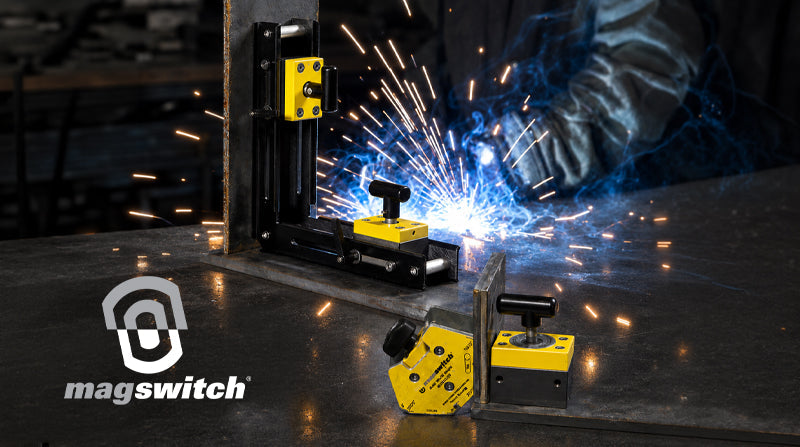
Switchable magnetic squares help to quickly align steel parts, reliably maintain defined angles, and achieve repeatable welding results.
Switchable magnetic squares facilitate the controlled positioning of ferromagnetic workpieces.
When welding, precise alignment often determines whether a construction fits immediately or requires extensive rework later. Even small deviations in frames, profiles, or assemblies can lead to dimensional errors and additional time expenditure.
Magnetic welding squares help to securely hold steel parts in position during alignment and tacking. Switchable models offer a particular advantage: they are initially applied without active holding force and are only switched on once the desired position is reached.
Why Magnetic Welding Angles Make Sense
Mechanical clamping devices, tacking points, and custom-made jigs remain indispensable in many applications. However, with frequently changing workpieces, they can slow down the setup process or make it unnecessarily complicated.
Magnetic squares offer a flexible solution for temporary positioning tasks. They can be quickly relocated and help to correctly align workpieces before final tacking or welding.
- Fast positioning of steel profiles and sheets
- Hands-free operation during alignment and tacking
- Repeatable positions for series production
- Less effort for temporary fixtures
More Control with Switchable Magnetic Technology
With a switchable magnet, the holding force is activated via a lever, rotary knob, or a similar mechanism. This allows the magnet to be precisely positioned first, without immediately sticking strongly to the workpiece.
Once the position is correct, the magnet is switched on. After the work step, it can be deactivated and removed or repositioned much more easily.
- Exact placement before switching on
- Easier release and repositioning of the tool
- Less adhering metal chips when switched off
- Controlled handling when setting up the workplace

Typical Areas of Application
Frame and Rack Construction
Square and rectangular tubes can be positioned faster for frames, bases, shelves, or protective structures.
Pipe and Profile Processing
Round pipes, profiles, and other components can be temporarily held during alignment or tacking.
Sheet Metal Processing
For suitable materials, magnetic squares assist in fixing sheet metal parts for tack, spot, MIG/MAG, or TIG welding.
Repetitive Parts
For recurring components, defined positions can be reproduced faster, and setup times between workpieces can be reduced.
Advantages for Workflow
Well-chosen positioning aids can improve speed, accuracy, and ergonomics at the welding workstation. Magnetic tools are particularly interesting when components need to be changed frequently or fixtures need to be flexibly adjusted.
- Shorter setup and positioning times
- Better alignment before tacking
- Fewer temporary tacking points
- More flexible use for changing projects

Choosing the Right Magnetic Square
Not every magnetic square is suitable for every application. Before selection, workpiece size, material thickness, contact surface, working position, and required holding force should be considered.
Frequent Questions
FAQ about Magnetic Welding Squares
How does a switchable magnetic welding square work?
The magnetic square is first positioned at the desired location. Then, the magnetic field is activated via the designated switching mechanism. To reposition or remove, the magnet is switched off again.
Can magnetic squares completely replace traditional clamping devices?
Not in every application. They are particularly suitable as quick positioning and tacking aids. For high loads, safety-critical work, or complex welding sequences, additional clamping devices and fixtures may be necessary.
Which metals are magnetic welding squares suitable for?
They work on ferromagnetic materials, such as many unalloyed and low-alloy steels. Aluminum, copper, and brass are not magnetic and therefore cannot be held directly. Some stainless steel grades also react only weakly or not at all magnetically.
Which welding processes can be supported with them?
Magnetic squares are primarily used for positioning and tacking and can support various processes such as MIG/MAG, TIG, MMA, or spot welding. The manufacturer's instructions and permissible working temperatures must be observed.
How do I find the right holding force?
Consider the weight, dimensions, and material thickness of the workpiece, as well as the direction of load. For vertical or overhead positions, additional safety reserves and, if necessary, mechanical safeguards are required.
What should I pay attention to before switching on?
The contact surfaces should be as clean, flat, and free of welding spatters as possible. Also, check the alignment of the components and keep hands and loose objects out of the potential clamping and adhesion area.
Find the Right Magnetic Square!
Discover solutions for quick and precise positioning of steel parts in welding shops, workshops, and metal construction.