Magnetism plays a crucial role in many industrial applications, particularly in the handling of steel materials. Two important concepts in this field are residual magnetization and residual circuits . This article examines these phenomena, their effects on different types of steel, and methods for addressing them in practice.
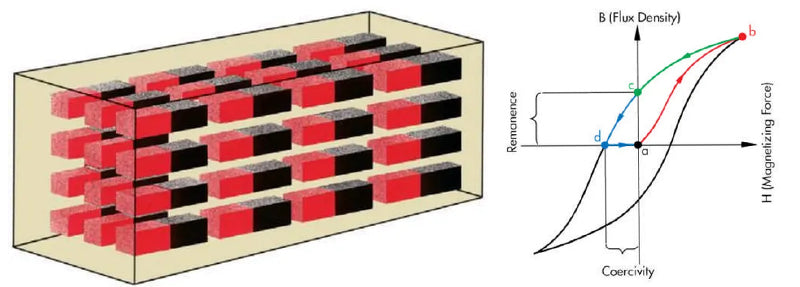
When a positive magnetic field is applied, the magnetic ions begin to align.
The stronger the magnetic field, the closer this alignment occurs. When all ions are aligned in the same direction, this is called magnetic saturation (point b).
When the external magnetic field is removed, the ions do not completely return to their random initial state. This leaves a residual magnetization in the material – an effect known as remanence (point c in Figure 3). 
Residual magnetism
Residual magnetism is defined as the amount of magnetization that remains after the removal of an external magnetic field. In other words, the value of the flux density retained by the magnetic material is called residual magnetism , and the material's ability to retain this magnetism is called retentivity .
Gauss is a unit of measurement for magnetic flux density. It was named in 1936 after the German mathematician and physicist Carl Friedrich Gauss . However, in the International System of Units (SI), the Tesla (symbol T) is used as the unit for magnetic flux density.
1 Tesla = 10,000 Gauss
| Field strength (Gauss) | Effect |
|---|---|
| >200 | Permanent magnet |
| ~20–40 | Paperclip sticks |
| >15 | Small metal parts stick |
| >10 | Small metal shavings adhere |
| >4 | Metal dust adheres |
| ~40–50 | Does arc welding interfere? |
| ~0.3–0.6 | Earth's field strength |
HIGH AND LOW CARBON STEEL
Low-carbon steels have low hysteresis, and their residual magnetism is weak. This residual magnetism is unstable and decays spontaneously.
High-carbon steels ("tool steels"), such as those found in bearings, gears, or knife blades, retain significantly more residual magnetism. They tend to generate residual circles , which may necessitate an air gap at the pole shoes to allow the part to detach efficiently.
Residual circle: A temporary phenomenon
A residual circuit is a temporary condition that occurs primarily in high-carbon steels. It creates a self-sustaining magnetic flux circuit , even when the magnet is switched off. In this case, the magnetic flux follows a closed loop: from the north pole of the permanent magnet, through the steel material, and back to the south pole.
Unlike residual magnetism, a residual circle disappears as soon as the part is separated from the magnet. However, it can cause problems when removing parts during magnetic handling .
Steel types and their magnetic properties
-
Carbon steel (A36, A529, A572, 1020, 1045, 4130)
-
Low-carbon steel (0.05–0.25% C): Low hysteresis, weak and unstable residual magnetism
-
Medium carbon steel (0.29–0.54% C): Medium magnetic properties
-
High-carbon steel (0.55–0.95% C): Stronger residual magnetism, prone to residual arcing.
-
-
Alloy steels (4140, 4150, 4340, 9310, 52100)
-
Residual magnetism and residual circuits are possible
-
-
Tool steels (D2, H13, M2)
-
Residual magnetism and residual circuits are possible
-
-
stainless steels
-
300 series: Non-magnetic
-
400 series: Significant reduction in magnetic effect
-
-
Ultra-high-strength steels (UHSS)
-
Exceptional hardness (50–65+ HRC) and high yield strength
-
Martensitic and TWIP variants can contain up to 0.8% carbon → residual circle phenomena
-
Can lead to wear on magnetic gripping surfaces
-
DEALING WITH RESIDUAL MAGNETISM AND RESIDUAL CIRCLES
-
vibration
Vibrations and shocks during handling can return the magnetic domains to their natural, disordered pattern.
A small steel part can be demagnetized by vibration. Sometimes, even the movement or handling of a part on a conveyor belt is enough to eliminate any residual magnetism.

warmth
The heat generated during processes such as hot forming, hot stamping, welding, painting ovens, machining processes, high-frequency hardening and heat treatments can often eliminate the residual magnetism left behind after handling with a magnetic gripper.
All ferromagnets possess a Curie temperature – the temperature at which their ferromagnetic properties disappear due to thermal excitation. At this temperature, the atoms of the material vibrate so intensely that tiny magnetic zones within the material, known as domains , lose their alignment. 
Demagnetizer (Degausser)
A demagnetizer is an electrical coil (solenoid) that is powered by electricity and can be used to demagnetize magnetic materials .
It is available in many versions to meet various industrial requirements – including tool demagnetizers , handheld devices , pen models and tabletop devices .
In all cases, the current generates a magnetic field whose strength and polarity change in order to rearrange the ions in the workpiece and thus cancel the magnetization.

air gaps
In residual circuits, introducing an air gap or a non-ferrous material between the magnetic poles and the steel can interrupt the circuit.
Special coatings
For high-carbon steels that tend to form residual circles, Magswitch offers coatings for pole shoes to improve the detachment of the parts.
Wear-resistant surfaces
For UHSS materials , specially designed sacrificial wear pads can protect the surfaces of the magnetic grippers.

CONCLUSION
Understanding residual magnetism and residual circuits is crucial for the efficient handling of steel materials in industrial applications.
While low-carbon steels generally cause only minor problems, high-carbon steels and tool steels require significantly more attention.
However, by using appropriate techniques and technologies, these magnetic phenomena can be effectively controlled, ensuring a smooth process in the handling and processing of steel.
For specific solutions related to residual magnetism or residual circuits, please contact our magnetic handling experts who can analyze your entire process and recommend tailored approaches.
Magswitch's application engineers are happy to assist you in developing a solution for your application by understanding your process from start to finish.
If you would like to learn more about how Magswitch can help you overcome challenges caused by residual magnetism or residual circuits, please contact us at sales@magswitch.com .
Our team of experts is always available to answer your questions or inquiries. You can also consult our catalog to see how Magswitch magnetic grippers are used in various industries and applications.